
You wake up, run your fingers through your hair, and notice more strands than usual on your pillow. Your hairline looks different. Your part is wider. You’ve been ignoring it for a while, but now it’s hard to look away.
If you’ve been searching for answers, you’ve probably come across two options: PRP treatment for hair loss or a hair transplant. And if you’re confused about which one is right for you — you’re not alone. This is one of the most common questions people ask before walking into a hair clinic.
Let’s break it all down simply, so you can make an informed decision without the overwhelm.
What Causes Severe Hair Loss in the First Place?
Before jumping to treatment, it helps to understand why hair falls. The most common cause is androgenetic alopecia — also called male or female pattern baldness. It affects nearly 50% of men by age 50 and up to 40% of women by age 70.
Other common triggers include hormonal changes (like thyroid issues or PCOS), nutritional deficiencies, chronic stress, and scalp conditions like dandruff or seborrheic dermatitis.
Doctors use tools like the Norwood Scale (for men) and the Ludwig Scale (for women) to measure how far hair loss has progressed. This stage is what determines which treatment will actually work for you — and this is where most people go wrong by self-diagnosing.
What Is PRP for Hair Loss — and How Does It Work?
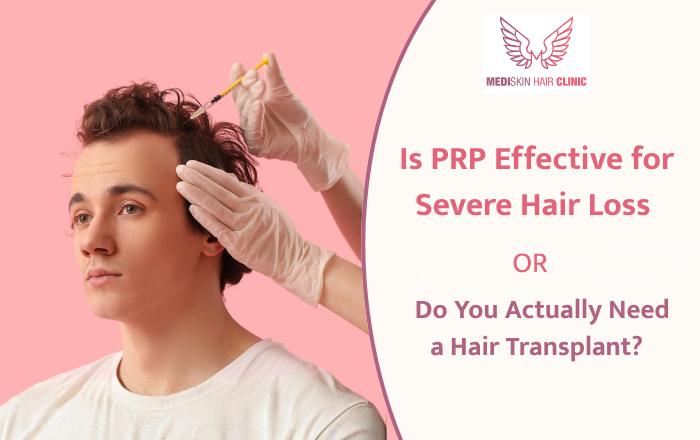
PRP stands for Platelet-Rich Plasma. It sounds complicated, but the idea is simple: a small amount of blood is drawn from your arm, spun in a centrifuge to concentrate the platelets, and then injected into the areas of your scalp where hair is thinning.
Those platelets contain growth factors that wake up dormant hair follicles, strengthen existing hair, and encourage healthier regrowth. Think of it like giving tired roots a nutritious boost from within — using your own body’s healing power, not any foreign substance.
A typical PRP hair treatment session takes around 45 to 60 minutes. There’s no downtime. Most people go straight back to work the same day. A standard course involves 3 to 6 sessions spaced about 4 to 6 weeks apart, followed by maintenance sessions every few months.
Clinical studies report that 70–80% of patients see visible improvement in hair density after completing a full PRP course — particularly when treatment begins early.
So, Is PRP Effective for Severe Hair Loss?
Here’s the honest answer: it depends on how much hair loss you’re dealing with.
PRP works brilliantly when:
- Your hair follicles are still alive but weak or dormant
- You’re in the early-to-moderate stages of thinning (Norwood Stage 1–3 or Ludwig Grade I–II)
- You want to maintain results after a hair transplant
- You’re a woman dealing with diffuse thinning linked to hormones
PRP may not be enough when:
- You have clearly visible bald patches with no fine hair visible
- Hair loss has been progressing for several years without treatment
- Your scalp shows little to no follicle activity
- You’ve already tried PRP with no response
The key thing to understand is this PRP cannot regenerate follicles that are already gone. It needs something to work with. If the follicles are still there (even if weak), PRP can produce great results. If they’ve been gone for years, no amount of PRP sessions will bring them back.
Hair Transplant vs PRP — Which One Is Actually Right for You?
A hair transplant (most commonly FUE — Follicular Unit Extraction) involves taking healthy hair follicles from a donor area (usually the back of your scalp) and placing them in areas of baldness. The transplanted hair is permanent and resistant to the hormones that cause pattern baldness.
Here’s a quick comparison:
| Factor | PRP Treatment | Hair Transplant |
|---|---|---|
| Procedure Type | Non-surgical | Surgical |
| Best For | Early to moderate loss | Moderate to advanced loss |
| Downtime | None | 3–7 days rest advised |
| Results Timeline | 3–6 months | 6–12 months |
| Permanence | Maintenance needed | Permanent |
Can both be combined?
Absolutely — and it’s actually one of the most effective approaches available. Many patients use PRP after a hair transplant to help grafts settle faster, reduce shedding, and improve overall density. It’s not either/or — for many people, it’s both.
What Results Can You Realistically Expect from PRP?
- Months 1–2: Less hair shedding, scalp feels healthier
- Months 3–4: Visible reduction in thinning, early new growth
- Months 5–6: Noticeable improvement in density and thickness
- Month 6+: Continued improvement with regular maintenance
Results vary depending on your age, the stage of hair loss, your platelet quality, and lifestyle factors like diet, sleep, and stress levels.
Why Getting the Right Diagnosis Matters More Than Anything
The biggest mistake people make is choosing a treatment before getting a proper assessment. PRP treatment for hair loss is widely available — but not every clinic takes the time to assess your actual follicle health before starting sessions.
A trained dermatologist uses tools like trichoscopy and scalp analysis to check whether your follicles are still active. This one step can save you months of time and money spent on the wrong treatment.
Ready to Find Out What’s Right for You?
If you’re struggling with hair loss, the smartest move is to speak with a specialist who will actually examine your scalp — not just recommend a generic treatment plan.
Dr. Shridevi Lakhe at MediSkin Hair Clinic, Kharadi is a qualified Dermatologist and Cosmetologist who specialises in hair PRP treatment. She assesses every patient individually and recommends the right path — whether that’s PRP, a transplant, or a combination based on what your scalp actually needs.
Name – Dr. Shridevi Lakhe | Dermatologist In Kharadi | Cosmetologist | MediSkin Hair Clinic
Address: Office No 1, M Floor, Soho by Panchshil Tower A, Upper Kharadi Main Rd, opp. YOO VILLAS, Kharadi, Pune, Maharashtra 411014
Phone: 86000 09731
Don’t wait for things to get worse. The earlier you act, the more options you have.
Frequently Asked Questions
Q1. Is PRP enough for severe hair loss?
For severe hair loss with significant bald patches, PRP alone usually isn’t enough. A hair transplant is typically recommended, with PRP used alongside to support results.
Q2. How many PRP sessions are needed?
Most patients need 3 to 6 sessions initially, followed by maintenance every 4 to 6 months.
Q3. Does PRP hurt?
A numbing cream is applied beforehand, so most people find it very tolerable. Mild soreness for a day or two afterwards is normal.
Q4. Can women benefit from PRP?
Yes — women with diffuse thinning linked to hormonal changes or PCOS often respond very well to PRP hair treatment.
Q5. Can PRP and a hair transplant be done together?
Yes, and this combination often delivers the best long-term results — especially for moderate to advanced hair loss.
Have questions? We’re just a message away! Contact us on WhatsApp — Click Here to Chat with Us